
Friday, August 31, 2018

Thursday, July 9, 2015
Thursday, August 7, 2014
Ballet Term of the Week - Pas de bourrée

It consists of three quick steps. A demi plié with extension of the first leg, closing the first leg to the second as the second rises to demi pointe or pointe, extending the second leg to an open position while both legs remain on demi or full pointe, and closing the first leg to the second in a demi plié. If the pas de bourrée is very quick or is the final step of an enchainement, the concluding demi plié may be omitted and the step will end with stretched knees. It means 'Step of Bourrée', Bourrée being an Auvergne dance. The name also translates as "stuffing step" with the initiating foot "stuffing" itself into the space occupied by the other foot and thereby forcing the other foot to move away. There are different kinds of pas de bourrée:
- pas de bourrée devant - "in front"
- pas de bourrée derrière - "behind"
- pas de bourrée dessus - "over"
- pas de bourrée dessous - "under"
- pas be bourrée en avant - "travelling forwards"
- pas de bourrée en arriere - "travelling backwards"
- pas de bourrée en tournant en dehors - "turning outwards"
- pas be bourrée en tournant en dedans - "turning inwards"
- pas de bourrée couru - "running" also "flowing smoothly as a river"
- pas de bourrée ouvert - "open," this is an "open->closed->open" sequence
- pas de bourrée piqué - "pricked"
Sunday, November 25, 2012
Ballet Term of the Week - Pas de basque
Pas de basque
"step of the Basques". Halfway between a step and a leap, taken on the floor (glissé) or with a jump (sauté); it can be done moving toward the front or toward the back. This step can also be found in Scottish highland dance.

Sunday, July 15, 2012
Ballet Term of the Week: Battement en cloche, grand
Battement en cloche, grand
[grahn bat-MAHN ahn klawsh] Large battement like a bell. A term of the French School and the Cecchetti method. Grands battements en cloche are continuous grands battements executed from the fourth position front or back en l'air to the fourth position back or front en l'air, passing through the first position. Same as grand battement jeté balancé, but the body remains upright as the leg swing.

Wednesday, October 26, 2011
Ballet Term of the Week - Passe'

Passé
As a position passé means when a foot is placed near, on, or below the other knee.
As a movement passé refers to the working foot passing close to the knee of the standing leg. When the foot arrives by the knee, it passes from the front to the back or back to front, and continues either to return to the floor by sliding down the supporting leg or into an arabesque or attitude etc.
Wednesday, September 21, 2011
Ballet Term of the Week - Chasse'
Chassé
[sha-SAY] Chased. A step in which one foot literally chases the other foot out of its position; done in a series.
[sha-SAY] Chased. A step in which one foot literally chases the other foot out of its position; done in a series.
Monday, March 21, 2011
Ballet Term of the Week - Glissade

Glissade
[glee-SAD]
Glide. A traveling step executed by gliding the working foot from the fifth position in the required direction, the other foot closing to it. Glissade is a terre à terre step and is used to link other steps. After a demi-plié in the fifth position the working foot glides along the floor to a strong point a few inches from the floor. The other foot then pushes away from the floor so that both knees are straight and both feet strongly pointed for a moment; then the weight is shifted to the working foot with a fondu. The other foot, which is pointed a few inches from the floor, slides into the fifth position in demi-plié. When a glissade is used as an auxiliary step for small or big jumps, it is done with a quick movement on the upbeat. Glissades are done with or without change of feet, and all begin and end with a demi-plié. There are six glissades: devant, derrière, dessous, dessus, en avant, en arrière, the difference between them depending on the starting and finishing positions as well as the direction. Glissade may also be done sur les pointes.
Tuesday, March 8, 2011
Ballet Term of the Week - Temps lie'

Step to connect; to thicken; a movement where the legs transfer the weight of the body from one leg to the other - it can be done front, side or back.
["joined movement"]. This is a term for a whole series of conventionally connected movements executed in the center of the room, often during an adagio. However, it is also the term for an independent form of a step.
In the basic form of the temps lié, stand in 5th position croiseé, arms in preparatory position. The working leg is drawn, without taking the toe off the floor, into croisé devant, while the supporting leg bends into demi-plié; simultaneously, the arms are raised into 1st position with the head slightly inclining towards the shoulder corresponding to the supporting leg. Then, the weight is transferred through demi-plié to croisé derrière onto what was the working leg. Here, both legs are completely stretched with the now working leg stretched toe to the floor in back. At the moment of weight transfer, the arm that corresponds to the now working leg is raised overhead, while the other arm opens sideward; the head turns towards the sideward arm. Finally, the working leg closes in 5th back; arms may remain or stay.
Thursday, February 10, 2011
Saturday, October 16, 2010
Ballet Term of the Week - Sous-sus

Sous-sus ["under-over"] (or sus-sous ["over-under"]). A relevé in a tight fifth position with one foot almost on top of the other.
Sunday, July 4, 2010
Ballet Term of the Week - Sickling

Sickling
This term is used for a fault in which the dancer turns his or her foot in from the ankle, thereby breaking the straight line of the leg.

Saturday, June 12, 2010
Ballet Term of the Week - Port de bras

Port de bras
[pawr duh brah]
Carriage of the arms. The term port de bras has two meanings: (1) A movement or series of movements made by passing the arm or arms through various positions. The passage of the arms from one position to another constitutes a port de bras. (2) A term for a group of exercises designed to make the arms move gracefully and harmoniously. In the Cecchetti method there are eight set exercises on port de bras.
In the execution of port de bras the arms should move from the shoulder and not from the elbow and the movement should be smooth and flowing. The arms should be softly rounded so that the points of the elbows are imperceptible and the hands must be simple, graceful and never flowery. The body and head should come into play and a suggestion of épaulement should be used. In raising the arms from one position to another the arms must pass through a position known in dancing as the gateway. This position corresponds to the fifth position en avant, Cecchetti method, or the first position, French and Russian Schools. In passing from a high position to a low one, the arms are generally lowered in a line with the sides. Exercises on port de bras can be varied to infinity by combining their basic elements according to the taste of the professor and the needs of the pupil.
Monday, June 7, 2010
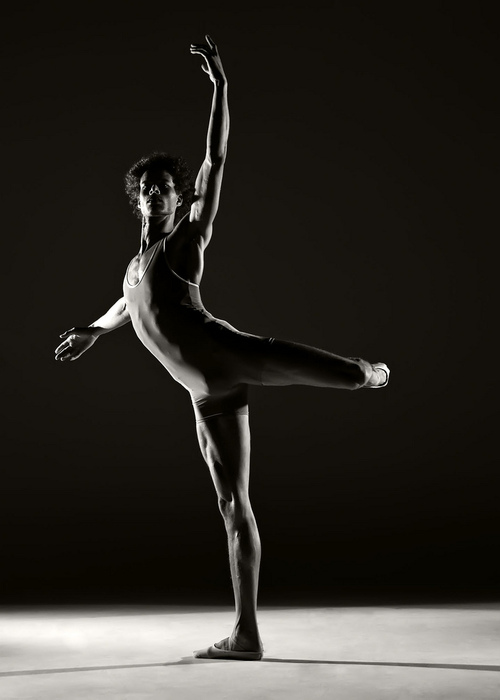
Ballet Term of the Week - Attitude
Attitude
[a-tee-TEWD]
A particular pose in dancing derived by Carlo Blasis from the statue of Mercury by Giovanni da Bologna. It is a position on one leg with the other lifted in back, the knee bent at an angle of 90 degrees and well turned out so that the knee is higher than the foot. The supporting foot may be à terre, sur la pointe or sur la demi-pointe. The arm on the side of the raised leg is held over the head in a curved position while the other arm is extended to the side. There are a number of attitudes according to the position of the body in relation to the audience.
Thursday, May 20, 2010
Ballet Term of the Week - Arabesque

Arabesque
[a-ra-BESK]
One of the basic poses in ballet, arabesque takes its name from a form of Moorish ornament. In ballet it is a position of the body, in profile, supported on one leg, which can be straight or demi-plié, with the other leg extended behind and at right angles to it, and the arms held in various harmonious positions creating the longest possible line from the fingertips to the toes. The shoulders must be held square to the line of direction. The forms of arabesque are varied to infinity. The Cecchetti method uses five principal arabesques; the Russian School (Vaganova), four; and the French School, two. Arabesques are generally used to conclude a phrase of steps, both in the slow movements of adagio and the brisk, gay movements of allégro.
Monday, May 10, 2010
Ballet Term of the Week - Battement frappé

Battement frappé
[bat-MAHN fra-PAY]
Struck battement. An exercise in which the dancer forcefully extends the working leg from a cou-de-pied position to the front, side or back. This exercise strengthens the toes and insteps and develops the power of elevation. It is the basis of the allegro step, the jeté
Sunday, May 2, 2010
Ballet Term of the Week - Sauté

Sauté, sautée
[soh-TAY]
Jumped, jumping. When this term is added to the name of a step, the movement is performed while jumping. As, for example, échappé sauté. Note: In all jumping movements the tips of the toes should be the first to reach the ground after the jump, then the sole of the foot followed by the heel. In rising from the ground the foot moves in the reverse order.
Monday, April 26, 2010
Ballet Term of the Week - Sur le cou-de-pied

Sur le cou-de-pied
[sewr luh koo-duh-PYAY]
On the "Neck" of the foot. The working foot is placed on the part of the leg between the base of the calf and the beginning of the ankle.
Sunday, April 18, 2010
Ballet Term of the Week - Relevé

Relevé
[ruhl-VAY]
Raised. A raising of the body on the points or demi-pointes, point or demi-pointe. There are two ways to relevé. In the French School, relevé is done with a smooth, continuous rise while the Cecchetti method and the Russian School use a little spring. Relevé may be done in the first, second, fourth or fifth position, en attitude, en arabesque, devant, derrière, en tournant, passé en avant, passé en arrière and so on.
Subscribe to:
Posts (Atom)

